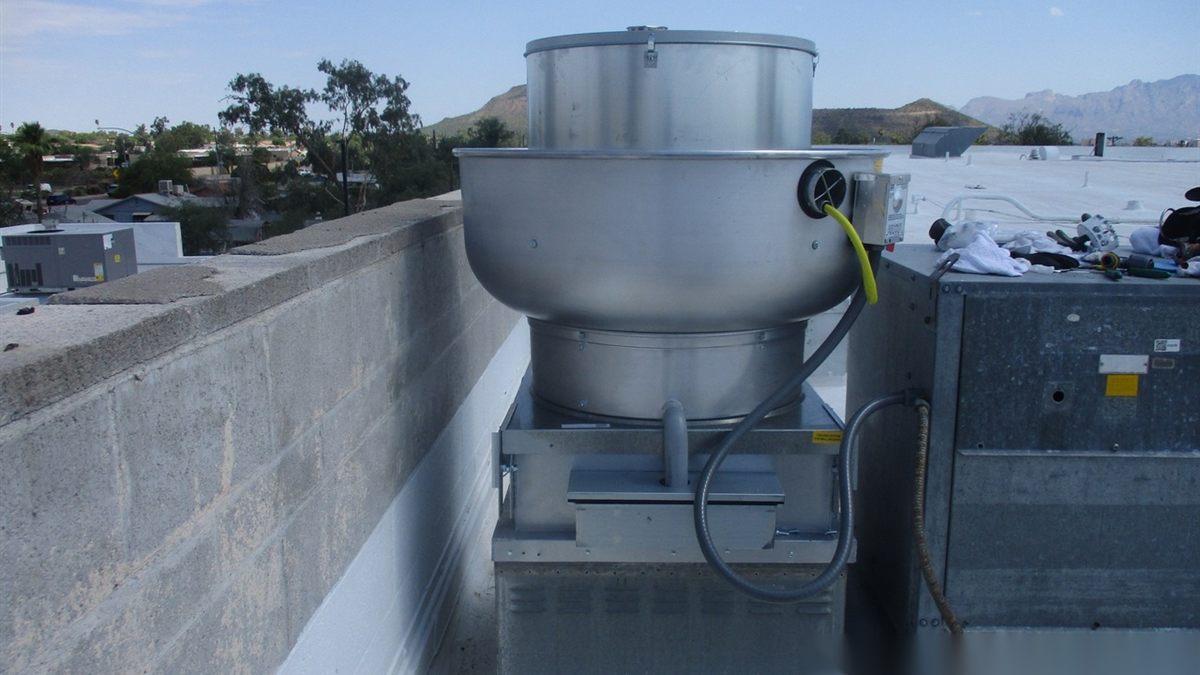
How many times does the enthusiasm of starting a job get turned into a demoralizing “what the heck am I getting into?” Picture this: you make it up to the roof and discover uncontained grease surrounding the exhaust fan. Even an experienced KEC tech can’t be blamed for feeling that they just got thrown under the bus with an undesirable job assignment. It is a fact that there is a difference in the work when you’re navigating around a minefield of grease just to be able to clean the fan… and on top of that, dealing with the collateral mess of tracking grease with every step including all the deposits left on roof access ladders.
In a “perfect world,” grease containment is in place and effective, and the roof does not require additional, unplanned time to just accomplish minimum standards of service. All things considered, that “perfect world” really should be “business as usual.” This discussion doesn’t have all the answers but there may be one possibility that you haven’t considered.
All too often, there is an assumption that grease is leaking from the fan, or it’s the result of careless workmanship of the cleaning tech. A good investigator won’t jump to conclusions. They will slow down, find the real source, and discover there can be more than one explanation for the unwanted grease on the roof. To start with, if the fan base is not properly sized and secured to the curb, the sloppy fit invites vibration to “dance” the fan into a position with gaps at the transition. Having hinges in place not only provides ready access for critical cleaning, but also secures the fans to the curb, eliminates high wind displacement, reduces damage from the rigors of manhandling in the normal course of service, helps extend the life of power supply conduits, and adds years to the useful life of the fan.
Another common culprit of uncontained grease are extensions mounted on top of fans, presumably to achieve clearance requirements between kitchen exhaust and fresh air intakes. In most cases, we have found the transition from the extension to the fan is not designed to capture the grease inside the fan. The result is grease leaking to the outside of the fan bowl with a direct path to the roof.
We’ve all seen fans that have been maintained with a life spanning well into a second decade, but there is a typical failure with older generation fans where the sheet metal of the fan bowl terminates at the connection to the fan base. As the seal deteriorates, grease can find its way out from the entire 360 degrees of that connection and almost any band-aid fix tends to be temporary at best. Newer generation fans have improved with a built-in trough at the inside bottom of the bowl that retains the accumulating grease between cleanings.
Everything mentioned so far can be in order, and there still may be an onslaught of grease on the roof that is interpreted by house management as less than satisfactory performance from the KEC operator. This is where you can put on a CSI hat and talk about the difference between splatter grease and aspiration grease, and expose a little science and physics that are a part of our grease-chasing world. Splatter grease can be identified with a stain pattern like a comet with a tail. This happens when a power washer hits an accumulation of grease and sends it flying predominantly in a horizontal trajectory. Compare that with grease that is carried through the airstream of the system and is projected vertically from the fan until gravity overcomes velocity and the droplet falls to the roof. You’ll find a distribution of coin size shapes predominantly in the direction from prevailing winds. This aspiration of grease is an event happening between the cleanings and not the result of tech workmanship. Properly identifying this opens the conversation to challenge issues of the fans’ CFM and cleaning frequency. We all like a robust exhaust flow for the hood but more is not always better. Making changes to the airflow can involve mechanical and electrical considerations. Sometimes the simplest fix is increasing the cleaning frequency to affect the volume of aspiration.
One of the values of IKECA membership is the access we have to aftermarket suppliers of grease containment solutions specifically designed for exhaust fans. Encourage your customers to invest in solutions that are engineered to handle the scope of the problem. IKECA has many Associate Members that supply this service. Don’t hesitate to reach out to them. They will help you help your customer with a fix that works and promotes your KEC operation as a part of the solution, not the problem.
Part of transforming that “perfect world” into a “business as usual” environment requires addressing all the little things that add up to making the job easier for the tech that’s dealing with it night after night. For all the things that I do as the leader of my business, paying attention to how I can make our tech’s jobs more easily and safely accomplished tops the list. We give bonuses to our techs that identify Code deficiencies and safety hazards. This campaign to help the customer stay on top of wear and tear maintenance and Code deficiencies can be further enhanced if there’s a third-party service report required by the local Fire Authority. I’ve found that embracing these programs has increased the opportunities for building better relationships with the AHJ community.
As the KEC operator of choice, we’re often asked to solve problems for our customers that may be outside our normal scope of work. Whether you’re guiding the customer in the direction of adding grease containment devices or simply teaching them the difference between splatter and aspiration as the origin of their problem, having the knowledge that leads the customer to the proper conclusion for the fix reaffirms your value as a subject matter expert.
Many of us grew up hearing the adage “The Customer is Always Right.” Perhaps it was motivated by wanting customers to feel ultimately appreciated and valued. We know customers are not always right, but the customer is always the customer. Knowing how far you’ll go to satisfy a customer are decisions you may calculate based on relationships or projections of earnings. If a customer is unwilling to sufficiently maintain the exhaust system, and they want their problems to be your problems, the best fix may be to have them find a new KEC provider. That might be a possibility that you haven’t considered.
Article Companion
Rooftop Grease Investigation at a Glance
| Condition described | Clue to investigate | Possible response discussed |
|---|---|---|
| Fan base or curb transition | Poor fit, movement, vibration, or gaps | Proper sizing, secure mounting, and hinges |
| Fan extension transition | Grease escaping outside the fan bowl | Evaluate how the extension captures grease |
| Older fan bowl connection | Seal deterioration around the full connection | Assess fan condition and durable repair options |
| Splatter grease | Comet-like stain pattern and horizontal trajectory | Review cleaning technique and containment |
| Aspiration grease | Coin-sized spots distributed with prevailing winds | Evaluate airflow, containment, and cleaning frequency |
Common Questions
Rooftop Exhaust Grease FAQs
Why is grease collecting around a rooftop exhaust fan?
Possible causes include a poorly fitted fan base, gaps at the curb transition, extension-to-fan leakage, deteriorated fan bowl seals, splatter during cleaning, or grease carried through the exhaust airstream.
What is the difference between splatter grease and aspiration grease?
Splatter grease is driven outward when cleaning water strikes accumulated grease and often leaves comet-like stains. Aspiration grease travels through the exhaust airstream, exits vertically, and falls after gravity overcomes its velocity.
How can exhaust fan hinges help rooftop maintenance?
Proper hinges provide cleaning access, secure the fan to the curb, reduce displacement and handling damage, protect power conduits, and can help extend fan life.
Can more frequent cleaning reduce rooftop grease?
In some situations, increasing cleaning frequency may reduce the volume of grease available for aspiration. Airflow changes should account for applicable mechanical and electrical considerations.
Primary Sources
Author Bio
Dennis Poulin, CECS
Bio:
Dennis Poulin, CECS, and President of R&G Vent Cleaning Services. A graduate of Arizona State University with a Bachelor’s in Business Administration and Marketing. Entered the KEC industry in June of 2006, CECS certified in October 2006, and has never missed an IKECA Conference since. Currently serves as the Membership Committee Chair, member of the Board of Directors, and current IKECA VP.
Author biography reproduced exactly as supplied with the original article.